Spec-Driven Development, like you’ve never seen.

The spec is now visual. Quick to review. Easy to grasp. A new superpower for you and your agent.

Get Spec Ultra

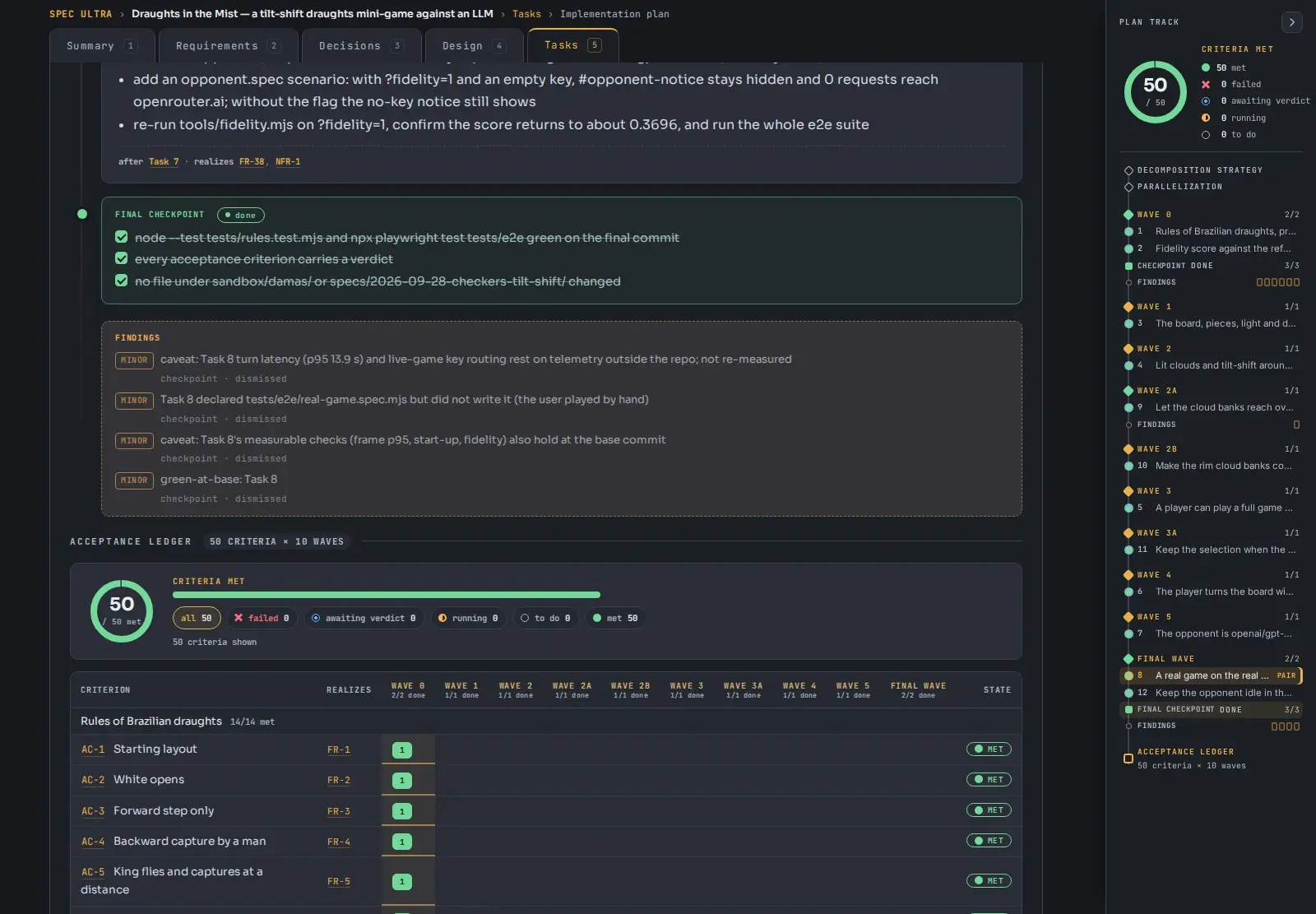
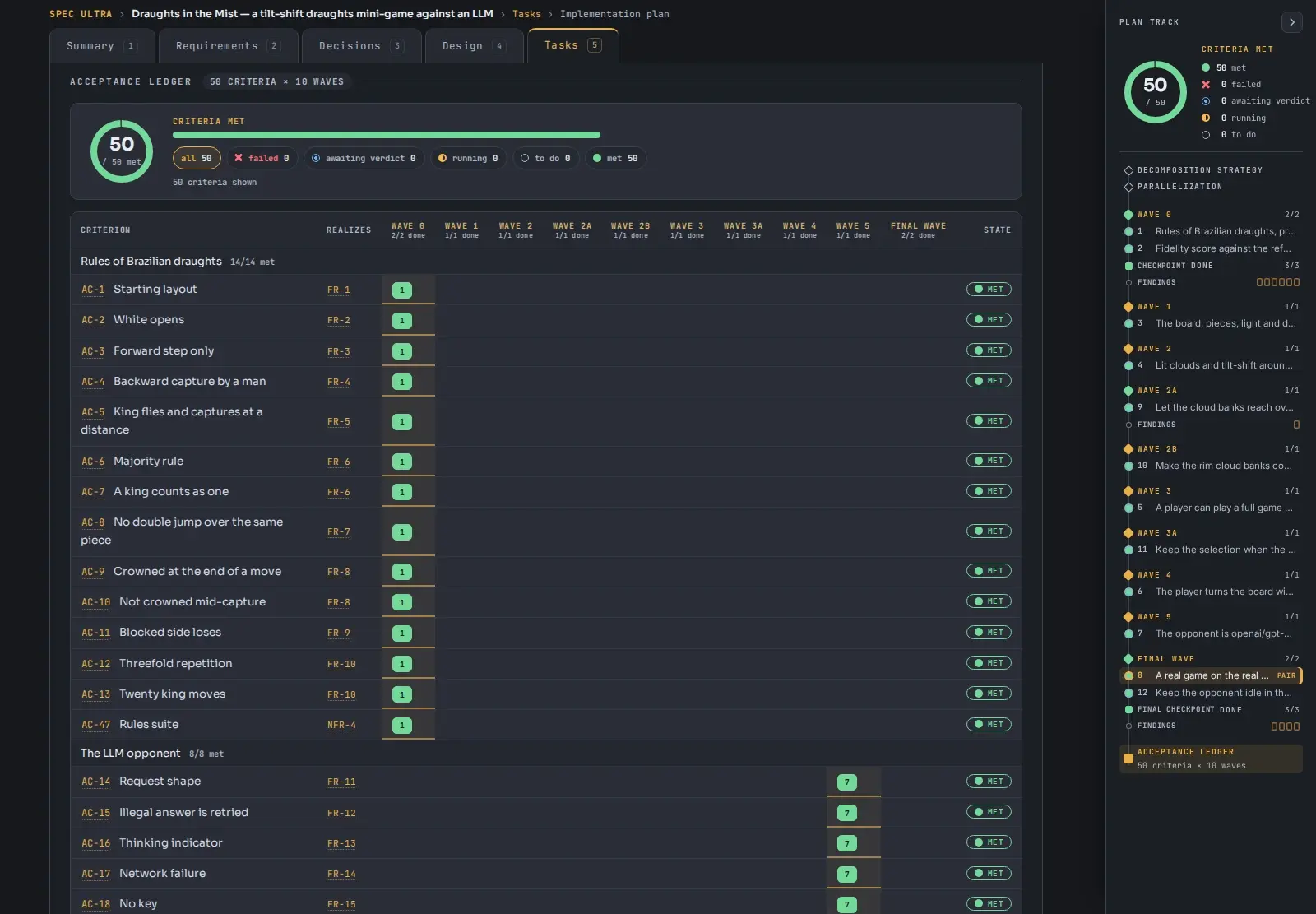
Every acceptance criterion, tracked to a verdict. The acceptance ledger: 50 criteria across 10 waves, each with its verdict — 50 met, 0 failed, 0 awaiting.

  1. 01Requirements4538 functional · 7 non-functional
  2. 02Criteria50given / when / then
  3. 03Tasks1211 agent · 1 pair · 0 human
  4. 04Checkpoints23 checks each
  5. 05Verdicts50/ 5050 met · 0 failed

What is spec-driven development (SDD)?

Spec-driven development

SDDnoun

Spec-driven development (SDD) captures requirements before any coding: the AI agent builds against the spec, and each acceptance criterion is checked against what was built.

The problem

Six ways agent work goes wrong. Six answers.

Each card is a pain. Turn it over for the answer.

What it tracks

From a sentence to a verdict.

Requirements, the criteria that prove them, the tasks that deliver them, the checkpoints the waves close through — and a verdict for every criterion. All five from one example spec: Brazilian draughts against an LLM, rendered as a tilt-shift miniature.
  1. 01Requirements45

    Every behaviour written as a testable sentence: when this happens, the system shall do that.

    FR-12

    Only legal moves reach the board

    If the model answers with a move that is not in the list of legal moves, or with an unreadable answer, then the system shall discard the answer and ask again, stating why the previous answer was rejected, up to 5 attempts per turn.

    NFR-6

    Key confinement

    The key appears only in local storage and in the Authorization header of requests to openrouter.ai.

    Measured as0 occurrences of the key in files under sandbox/damas-nevoa/ and 0 requests carrying it to any other host

    Next — the criteria that prove them

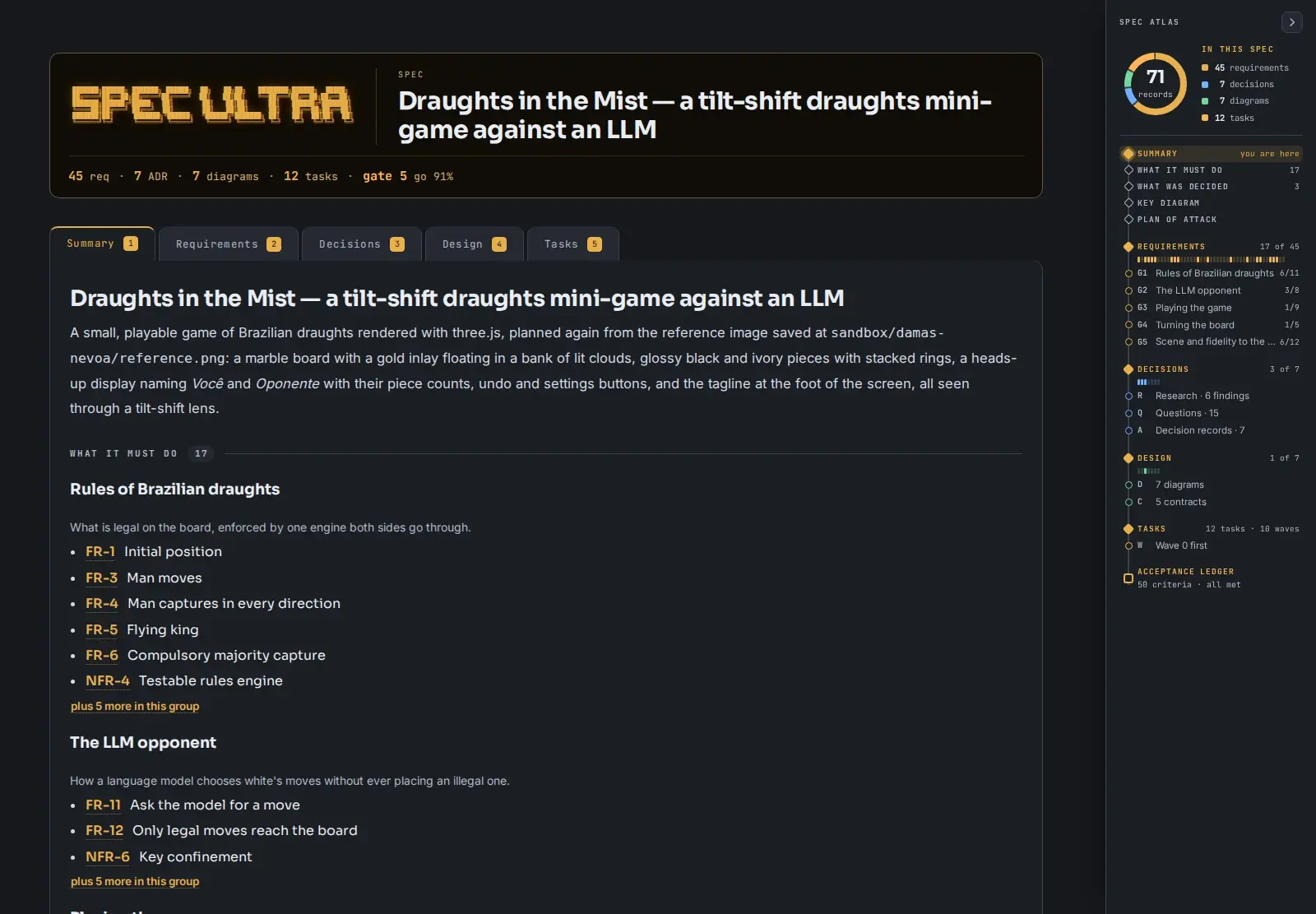
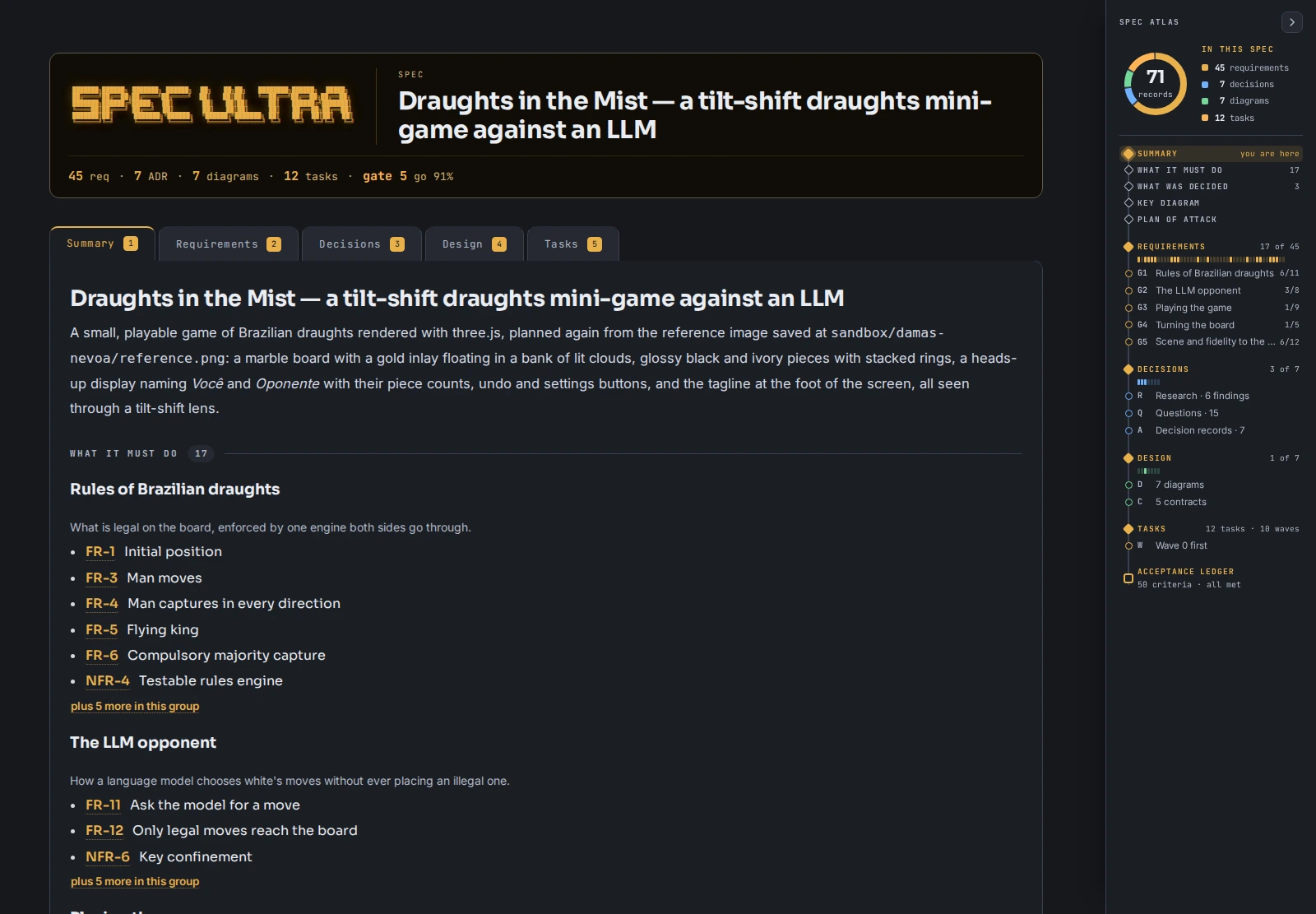
    The whole plan on one page — screenshot of the Summary tab
    Summary tab · The whole plan on one pageMasthead, totals and the spec atlas: 45 requirements, 7 decisions, 7 diagrams, 12 tasks.
  2. 02Criteria50

    Each criterion names the requirement it realizes and carries its own status.

    AC-15

    Illegal answer is retried

    realizes FR-12
    given
    a model answer naming a move absent from the legal list
    when
    the answer is processed
    then
    the board is unchanged and a new request is sent whose message quotes the rejected move and the reason

    Next — the tasks that deliver them

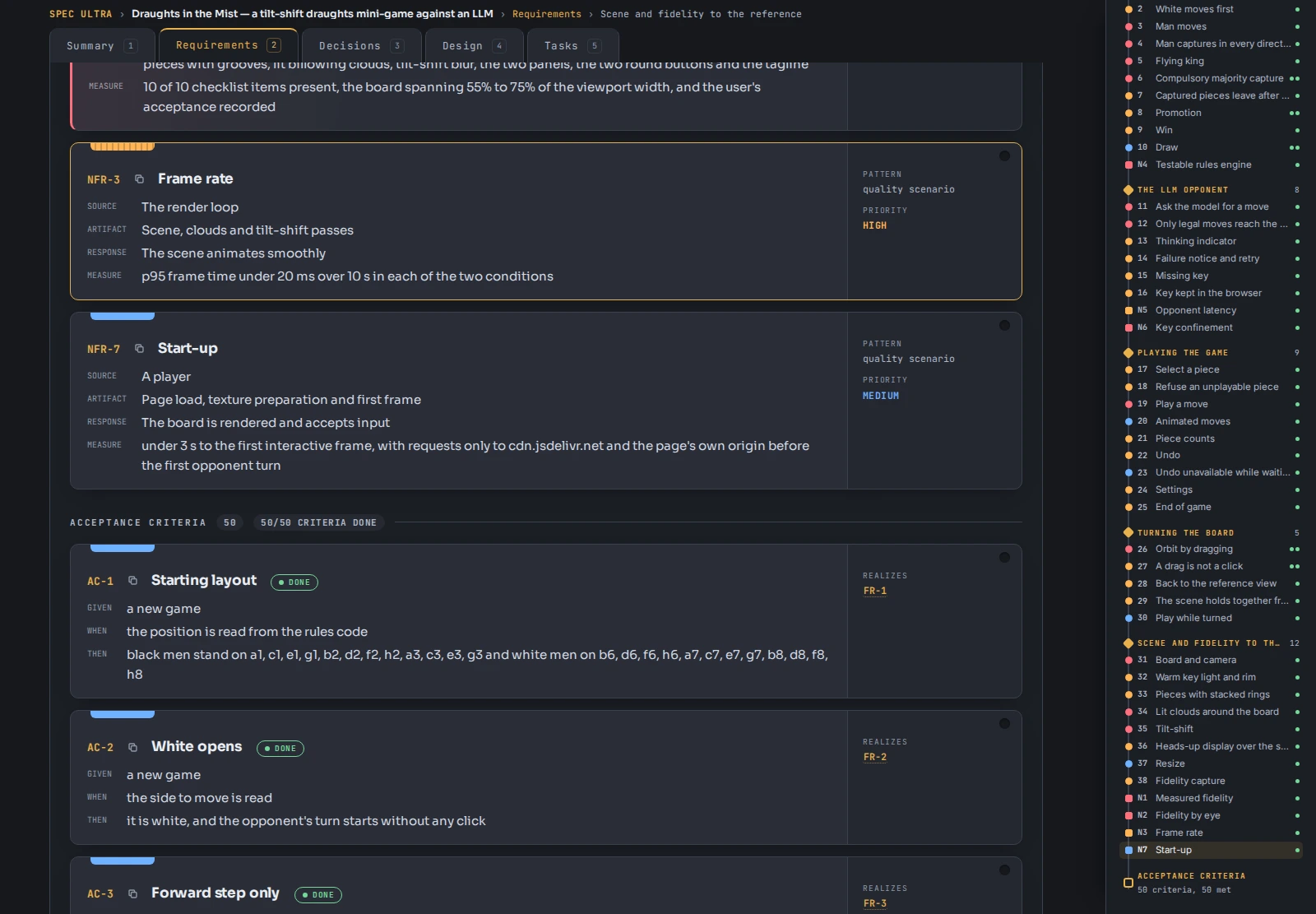
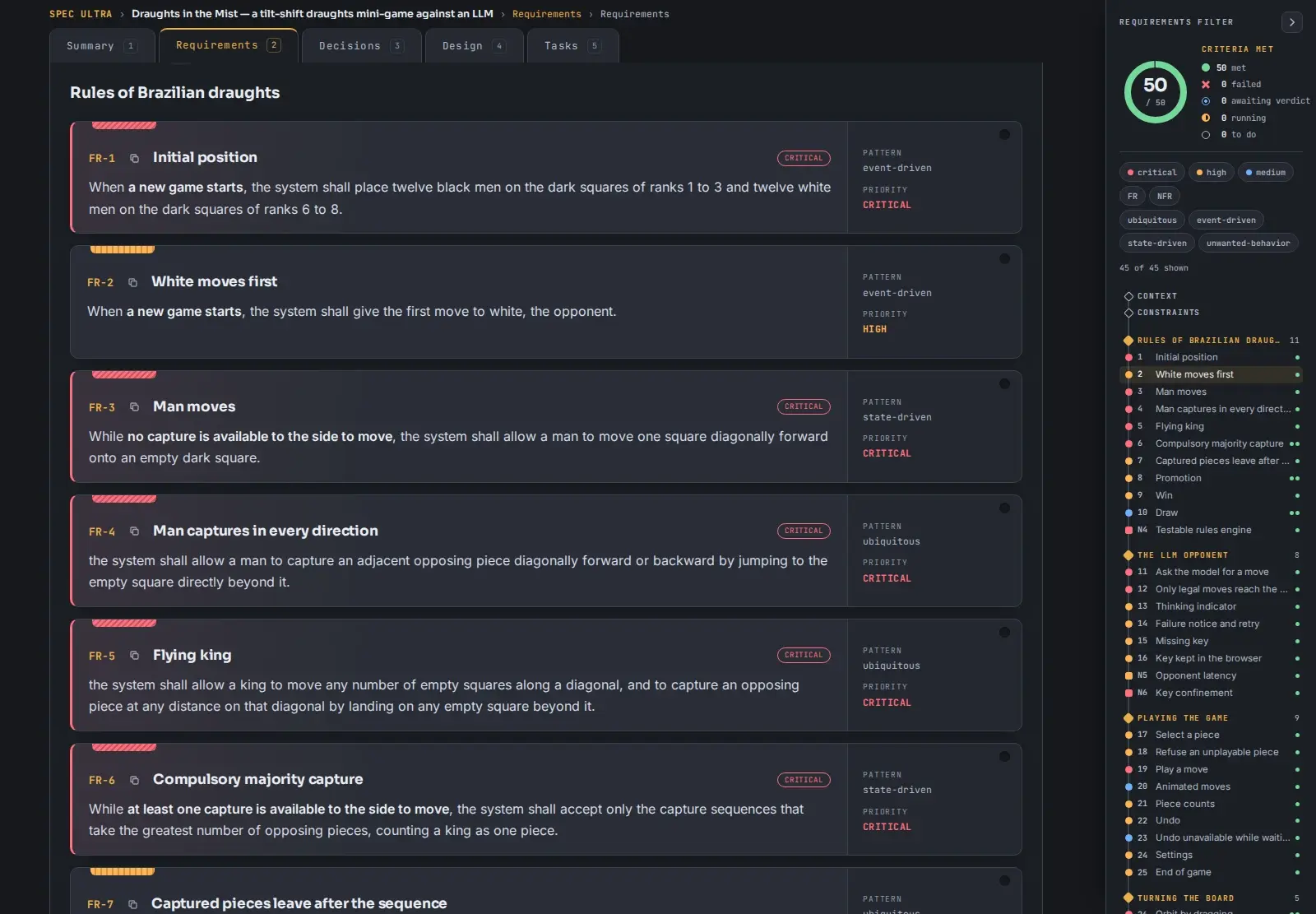
    Criteria written as given / when / then — screenshot of the Requirements tab
    Requirements tab · Criteria written as given / when / thenEach criterion names the requirement it realizes and carries its own status.
  3. 03Tasks12

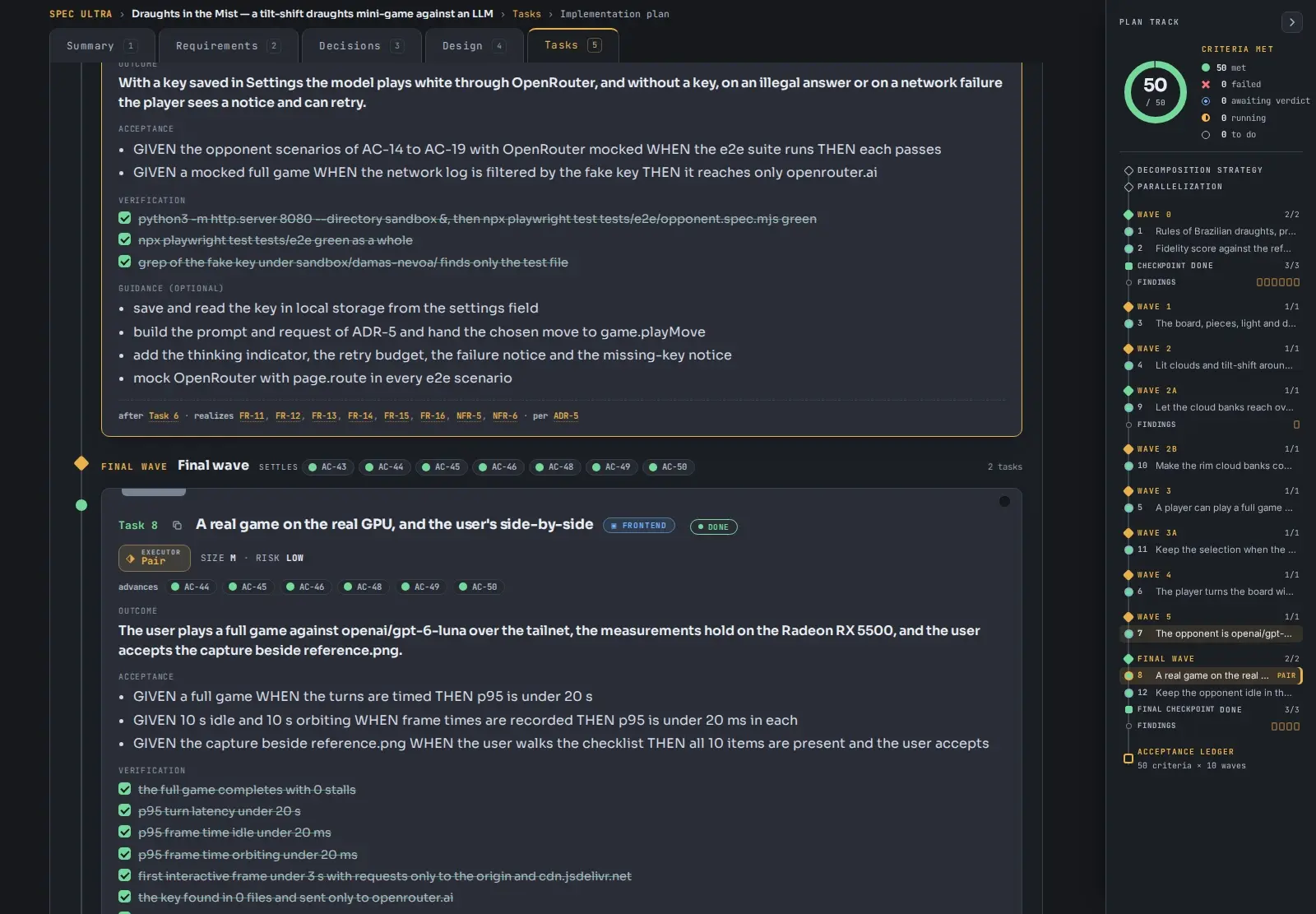
    Each task gets its executor at planning, by what the task needs — Task 8 runs as Pair because it needs the real GPU and the user’s eyes.

    Agent11

    Runs on its own: a subagent implements the task and the wave verifier checks it.

    Pair1

    Runs with you: the agent works in your session and asks before every action that changes state.

    Human0

    Waits for you: the task is handed over with its steps and checks, and is marked done only when every check passes.

    Task 8PairA real game on the real GPU, and the user's side-by-side

    Next — the checkpoints the waves close through

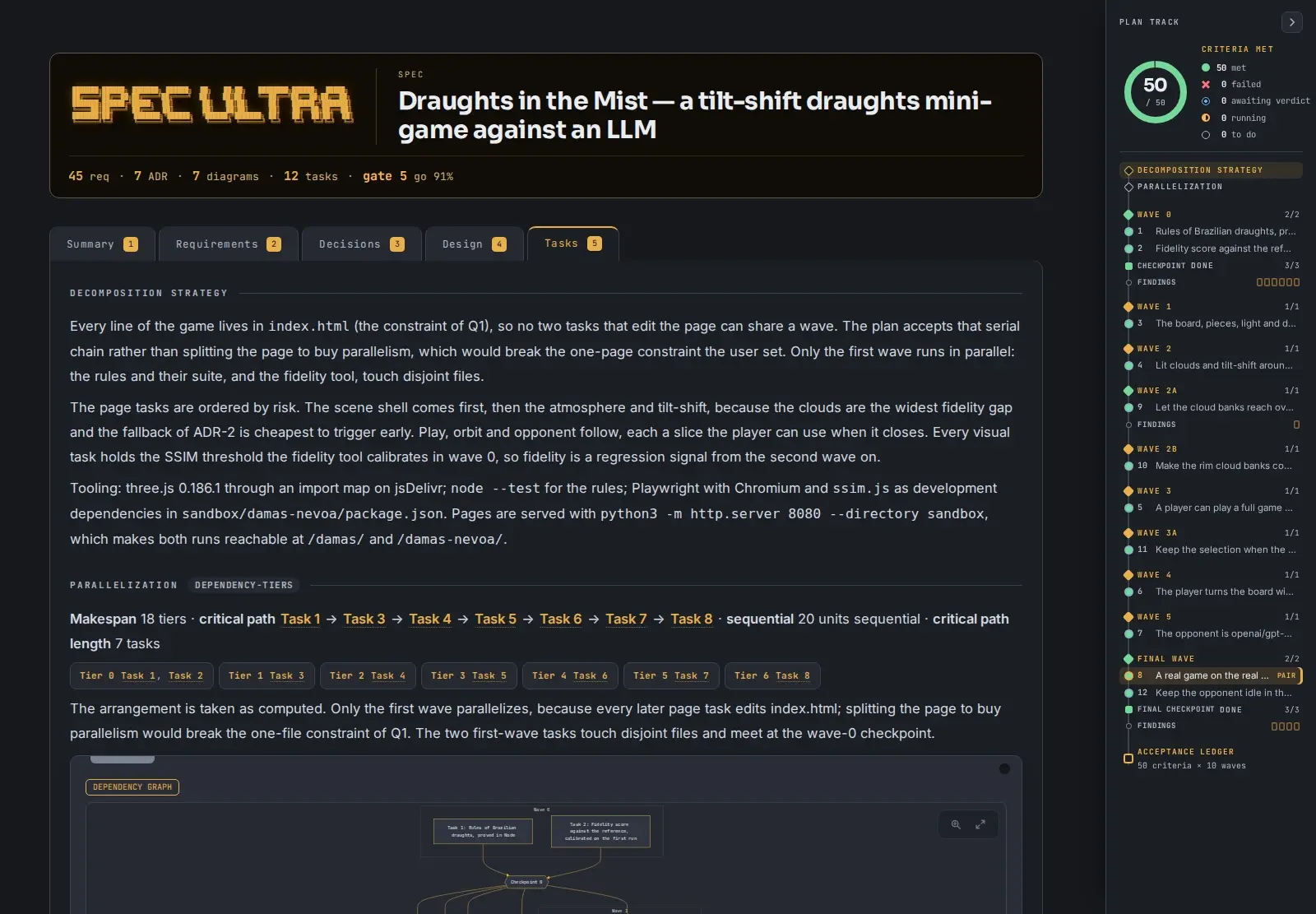
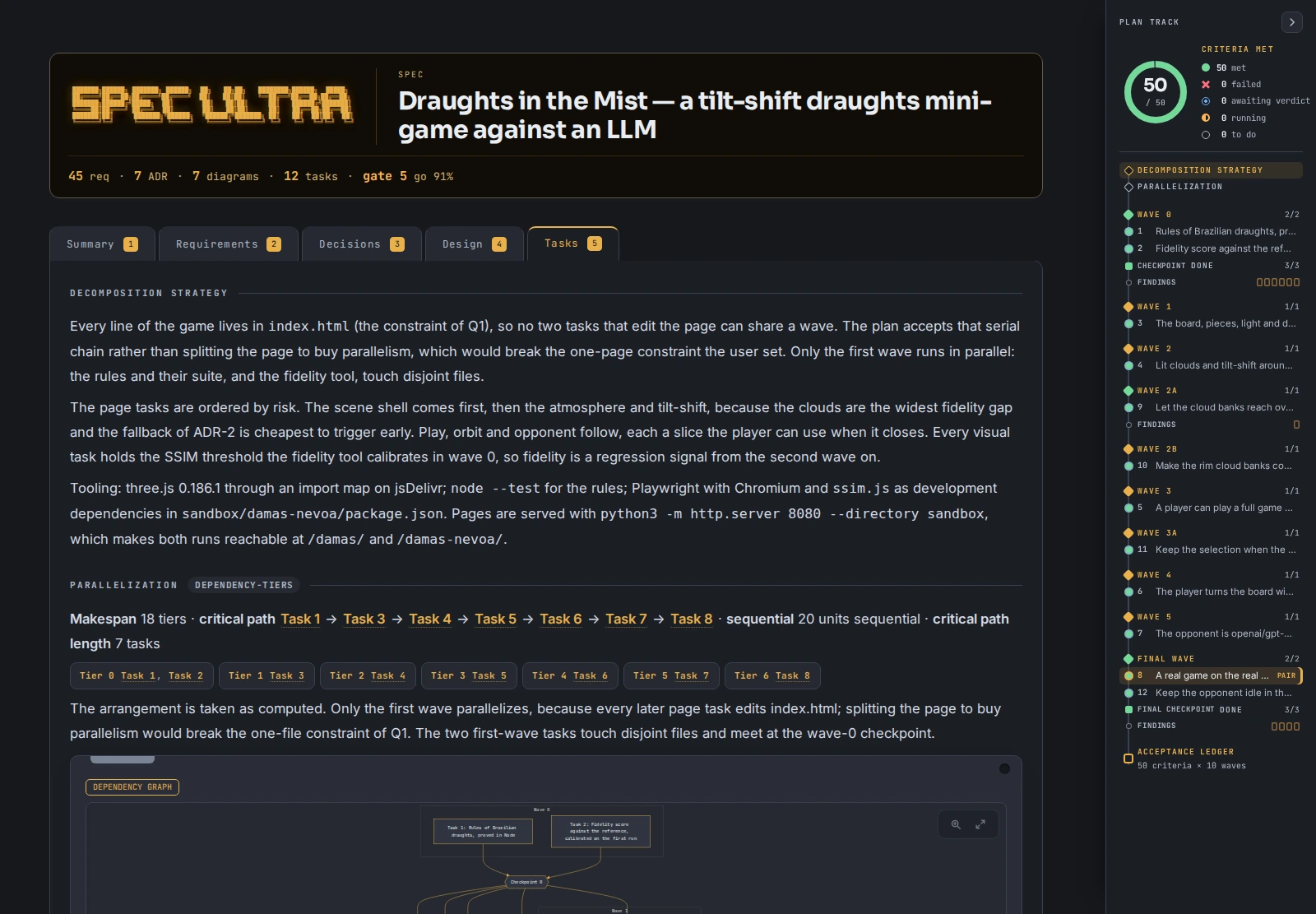
    The plan of attack — screenshot of the Tasks tab
    Tasks tab · The plan of attackWhy the tasks are ordered this way, the computed critical path, and the plan track.
  4. 04Checkpoints2

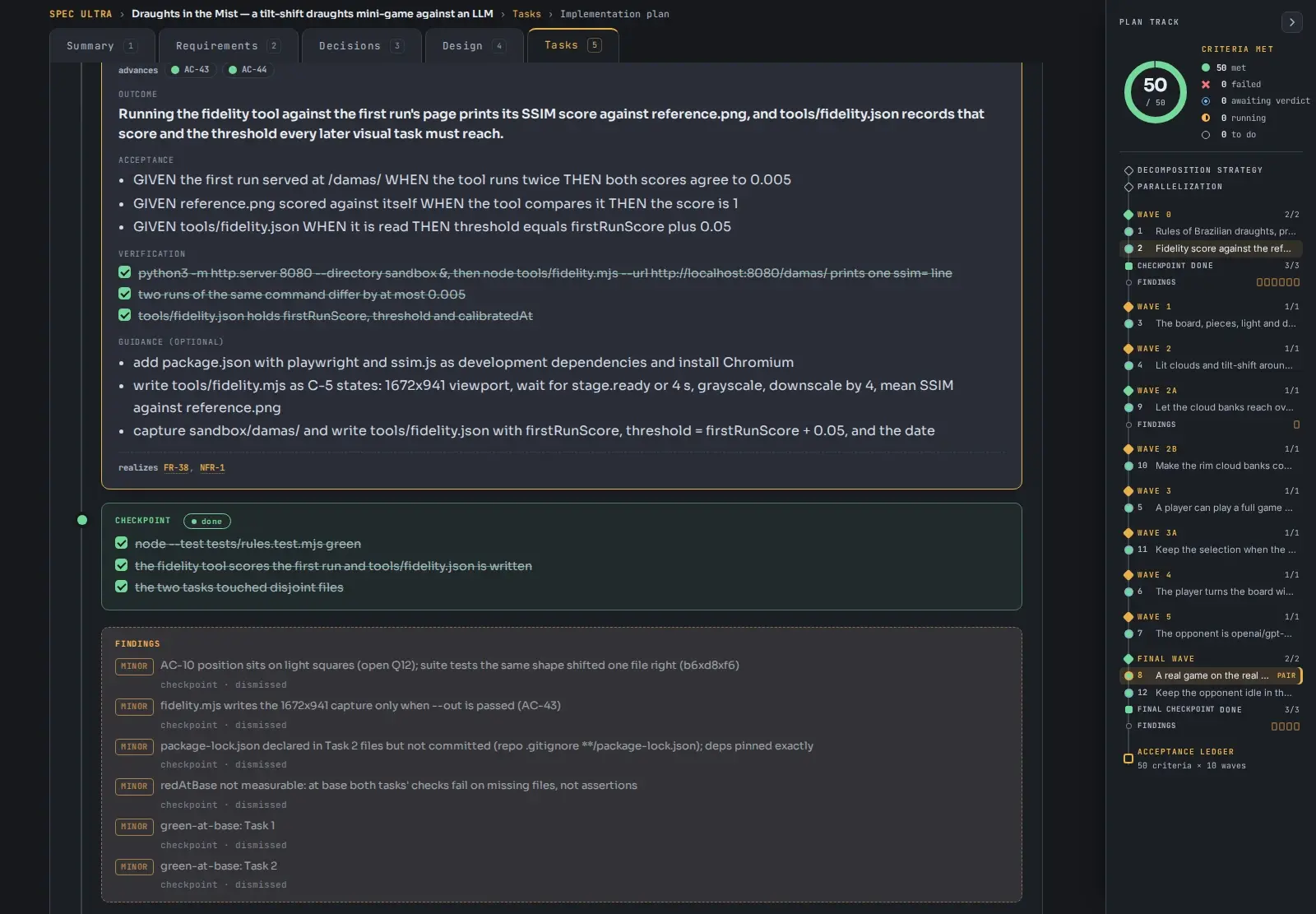
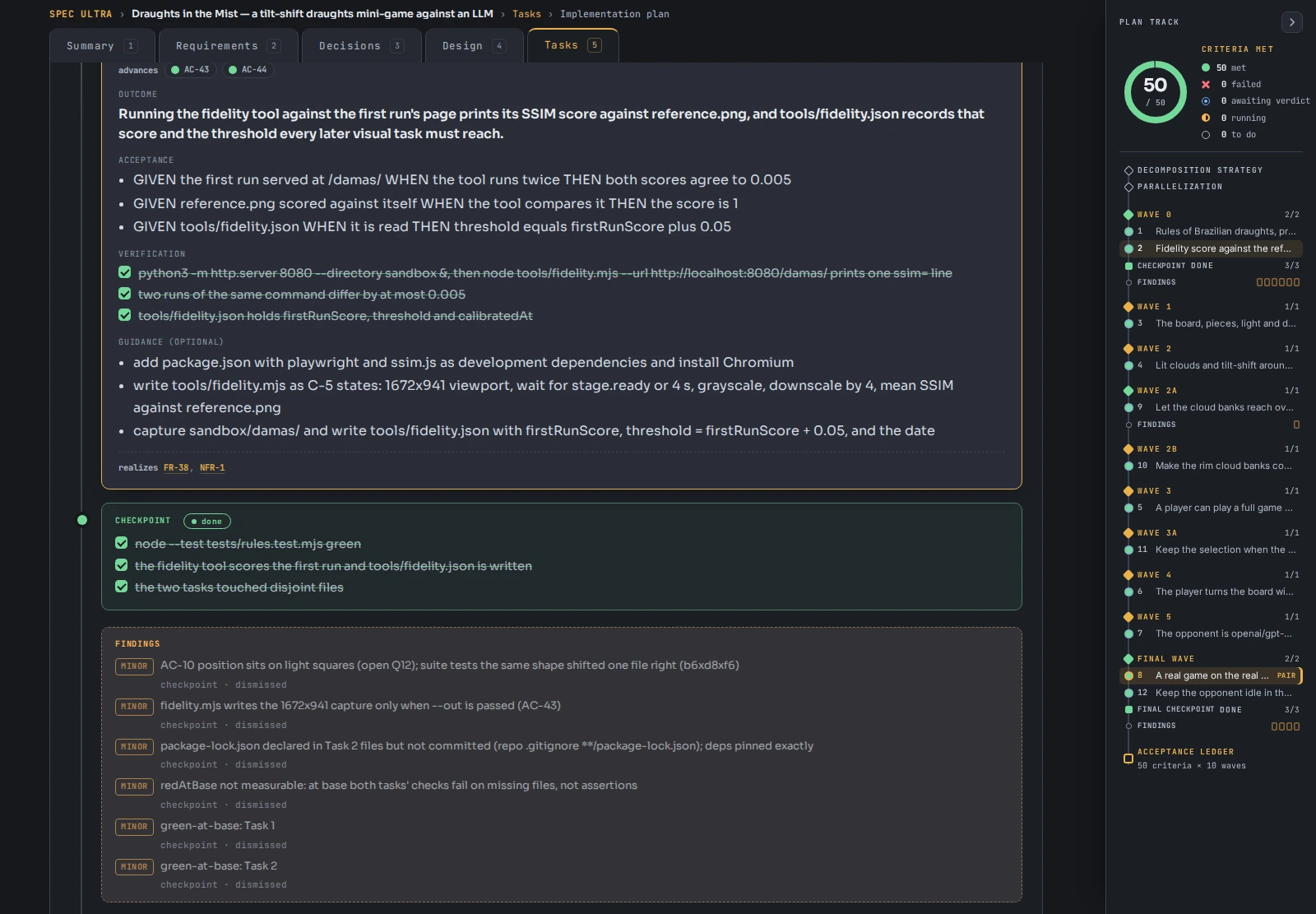
    Wave 0 closes only when its three checks pass; the findings the verifier raised sit right under it.

    Checkpointcloses wave 0 · 3 checks

    • node --test tests/rules.test.mjs green
    • the fidelity tool scores the first run and tools/fidelity.json is written
    • the two tasks touched disjoint files

    Final checkpointcloses wave 6 · 3 checks

    • node --test tests/rules.test.mjs and npx playwright test tests/e2e green on the final commit
    • every acceptance criterion carries a verdict
    • no file under sandbox/damas/ or specs/2026-09-28-checkers-tilt-shift/ changed

    Next — a verdict for every criterion

    A wave closes through its checkpoint — screenshot of the Tasks tab
    Tasks tab · A wave closes through its checkpointWave 0 closes only when its three checks pass; the findings the verifier raised sit right under it.
  5. 05Verdicts50/ 50

    Every acceptance criterion is tracked to a verdict — measured by a test, or judged by a person when only a person can judge it.

    CriterionRealizesVerdict
    AC-1Starting layoutFR-1met
    AC-2White opensFR-2met
    AC-15Illegal answer is retriedmeasured by a testFR-12met
    AC-26Undo disabled while the opponent thinksFR-23met
    AC-43The check reports a scoreFR-38met
    AC-45Checklist and acceptancejudged by a personNFR-2met
    AC-49Key nowhere elseNFR-6met
    AC-50Start-up timeNFR-7met

    8 of the 50 rows · 50 met.

    Next — the same five, on the real page

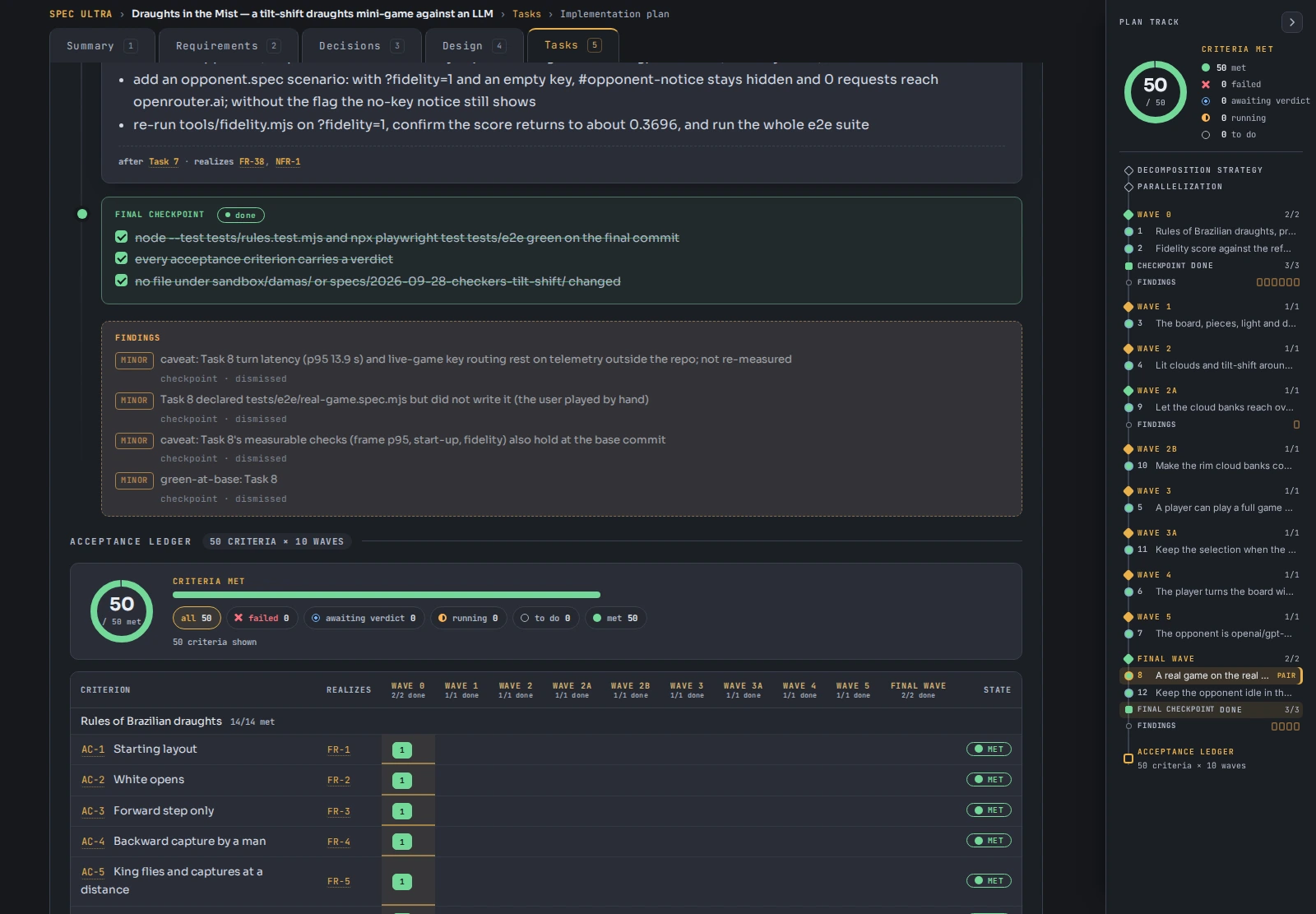
    Every acceptance criterion, tracked to a verdict — screenshot of the Tasks tab
    Tasks tab · Every acceptance criterion, tracked to a verdictThe acceptance ledger: 50 criteria across 10 waves, each with its verdict — 50 met, 0 failed, 0 awaiting.

The real page

The same spec, on the page it compiles to.

The real page Spec Ultra compiled for this spec: five tabs, rails, live cross-links. Open it full screen and click around.
  1. Summary 101 / 08

    The whole plan on one page

    Masthead, totals and the spec atlas: 45 requirements, 7 decisions, 7 diagrams, 12 tasks.

    The whole plan on one page — screenshot of the Summary tab
  2. Requirements 202 / 08

    Every behaviour written as a testable sentence

    When this happens, the system shall do that.

    FR-12

    Only legal moves reach the board

    If the model answers with a move that is not in the list of legal moves, or with an unreadable answer, then the system shall discard the answer and ask again, stating why the previous answer was rejected, up to 5 attempts per turn.

    AC-15
    Illegal answer is retried
    given
    a model answer naming a move absent from the legal list
    when
    the answer is processed
    then
    the board is unchanged and a new request is sent whose message quotes the rejected move and the reason
    Criteria written as given / when / then — screenshot of the Requirements tab

    Each criterion names the requirement it realizes and carries its own status.

  3. Decisions 303 / 08

    State-of-the-art decision support

    Every real choice weighed against named criteria, with sourced grades and a sensitivity check — and you make the call.

    ADR-5 · How should the LLM opponent answer, so that only legal moves reach the board?

    o1133

    Indexed legal-move menu answered through a JSON schema — chosen

    o2105

    Free move notation parsed and validated by the page

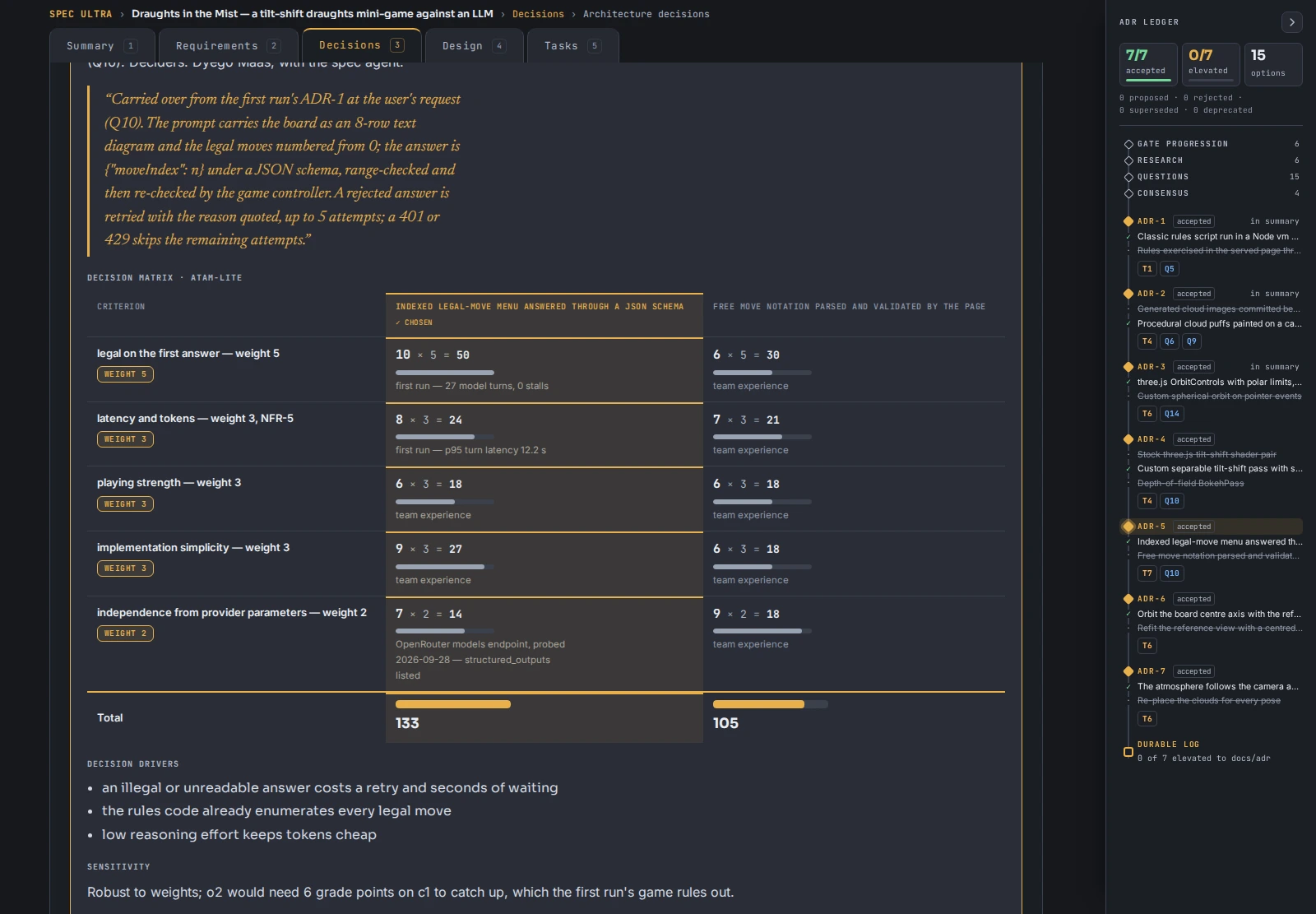
    Robust to weights; o2 would need 6 grade points on c1 to catch up, which the first run's game rules out.

    Weighted total = Σ weight × grade, weights 1–5, grades 1–10 · 5 criteria, weights 5, 3, 3, 3, 2.

    A decision, weighed — screenshot of the Decisions tab

    ADR-5: two options, five weighted criteria, sourced grades — o1 at 133 against o2 at 105.

  4. Design 404 / 08

    The design, drawn

    17 kinds of diagram — context maps, sequences, state machines, data models, timelines and more — and each part of the problem is drawn with the kind that explains it best.

    C4 semantic levelsc4-contextc4-containerc4-componentc4-deployment
    behaviorsequencestatejourney
    structureclasserarchitectureblock
    flow / free-formflowchart
    evolution / planningmigrationgitgraphtimelinegantt
    conceptmindmap

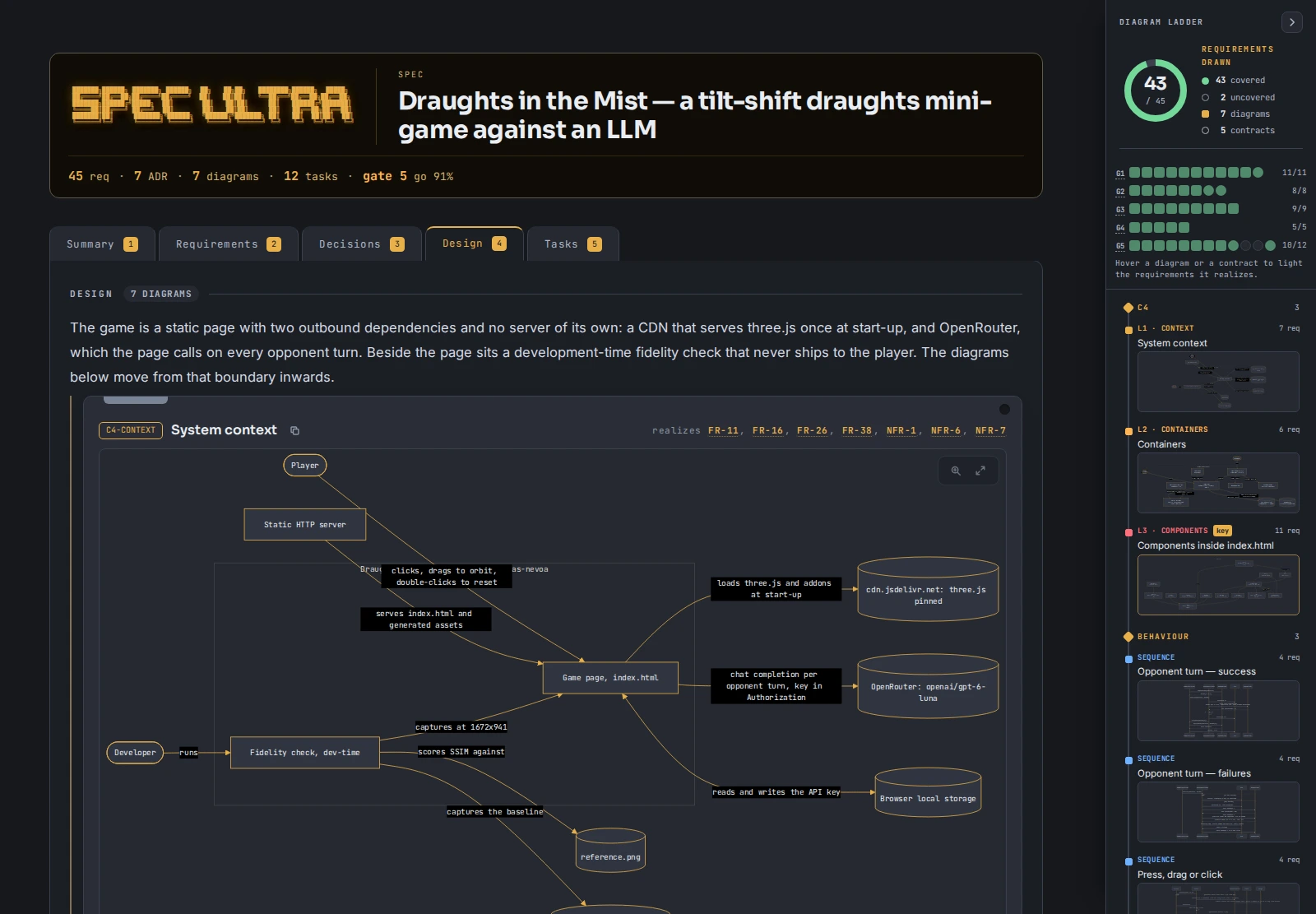
    This spec needed a context map and six sequence diagrams.

    The design, drawn — screenshot of the Design tab

    The system context and six more diagrams, each tied to the requirements it covers — 43 of 45 drawn.

  5. Tasks 505 / 08

    The plan of attack

    Small vertical slices, each tied to the requirements it delivers. The dependency graph is computed into waves, so independent tasks run in parallel and nothing waits longer than it must.

    AgentPaircheckpointcritical path

    12tasks
    10waves
    8critical path
    19 vs 25complexity points
    The plan of attack — screenshot of the Tasks tab

    Why the tasks are ordered this way, the computed critical path, and the plan track.

  6. Tasks 506 / 08

    A wave closes through its checkpoint

    Wave 0 closes only when its three checks pass; the findings the verifier raised sit right under it.

    Checkpointcloses wave 0 · 3 checks

    • node --test tests/rules.test.mjs green
    • the fidelity tool scores the first run and tools/fidelity.json is written
    • the two tasks touched disjoint files
    A wave closes through its checkpoint — screenshot of the Tasks tab
  7. Tasks 507 / 08

    The report is a claim; the diff is the fact.

    At every checkpoint, a fresh agent that wrote none of the code checks the wave against the diff, free of the bias of the agents it judges.

    11 of them, in full, under Proof.

    A wave closes through its checkpoint — screenshot of the Tasks tab

    Wave 0 closes only when its three checks pass; the findings the verifier raised sit right under it.

  8. Tasks 508 / 08

    Every acceptance criterion, tracked to a verdict

    Every acceptance criterion is tracked to a verdict — measured by a test, or judged by a person when only a person can judge it.

    50 met · 0 failed · 0 awaiting — every criterion by the wave that proved it.

    Every acceptance criterion, tracked to a verdict — screenshot of the Tasks tab

    The acceptance ledger: 50 criteria across 10 waves, each with its verdict — 50 met, 0 failed, 0 awaiting.

Who runs each task

Agent, Pair or Human — chosen per task.

Runs each wave and hands every task to an agent, to you, or to both of you together.

Each task gets its executor at planning, by what the task needs — Task 8 runs as Pair because it needs the real GPU and the user’s eyes.

A task run together with you — screenshot of the Tasks tab
Tasks tabA task run together with you. Task 8 runs as Pair: the agent works with the user on the real GPU, and the user accepts the capture beside the reference.

Pair · 1 of 12 tasks in this spec — task 8

The plan

The plan is computed from the dependency graph.

Every task declares what it depends on; the plan is computed from that graph. Tasks with no path between them share a wave and run in parallel. The amber line is the critical path. Green hexagons are checkpoints: the next wave starts only after every check passes. Adaptive plan: Gate 5 closed on 8 tasks in 7 waves; during the run, the integrators inserted Tasks 9 to 12, dashed in the graph. The makespan is the Gate 5 plan's.

planHow the 12 tasks were scheduled12 of 12 done

Only waves that run tasks side by side need a checkpoint.

Hover, focus or tap a checkpoint for its 3 checks
12tasks
10waves
8tasks on the critical path
19 vs 25complexity points

critical path · task134567128

Complexity points = each task weighed by its complexity: low = 1, medium = 2, high = 4, very high = 8. In waves, each wave lasts as long as its heaviest task.

The method

Two commands. The whole method.

Two commands run the whole method. Resume and status are there when you need them.

  • /spec-ultra:resume
  • /spec-ultra:status

Two acts · on a loop

in the example spec

50 of 50 criteria met, with 11 findings raised by an independent verifier agent.

Verdicts

Every acceptance criterion, tracked to a verdict.

Every acceptance criterion is tracked to a verdict — measured by a test, or judged by a person when only a person can judge it.

50/ 50 met
  • AC-15measured by a testIllegal answer is retried
  • AC-45judged by a personChecklist and acceptance
AC-45

Checklist and acceptance

judged by the user
given
a capture at 1672×941 beside reference.png
when
the user walks the 10-item checklist
then
all 10 items are present and the user accepts the result

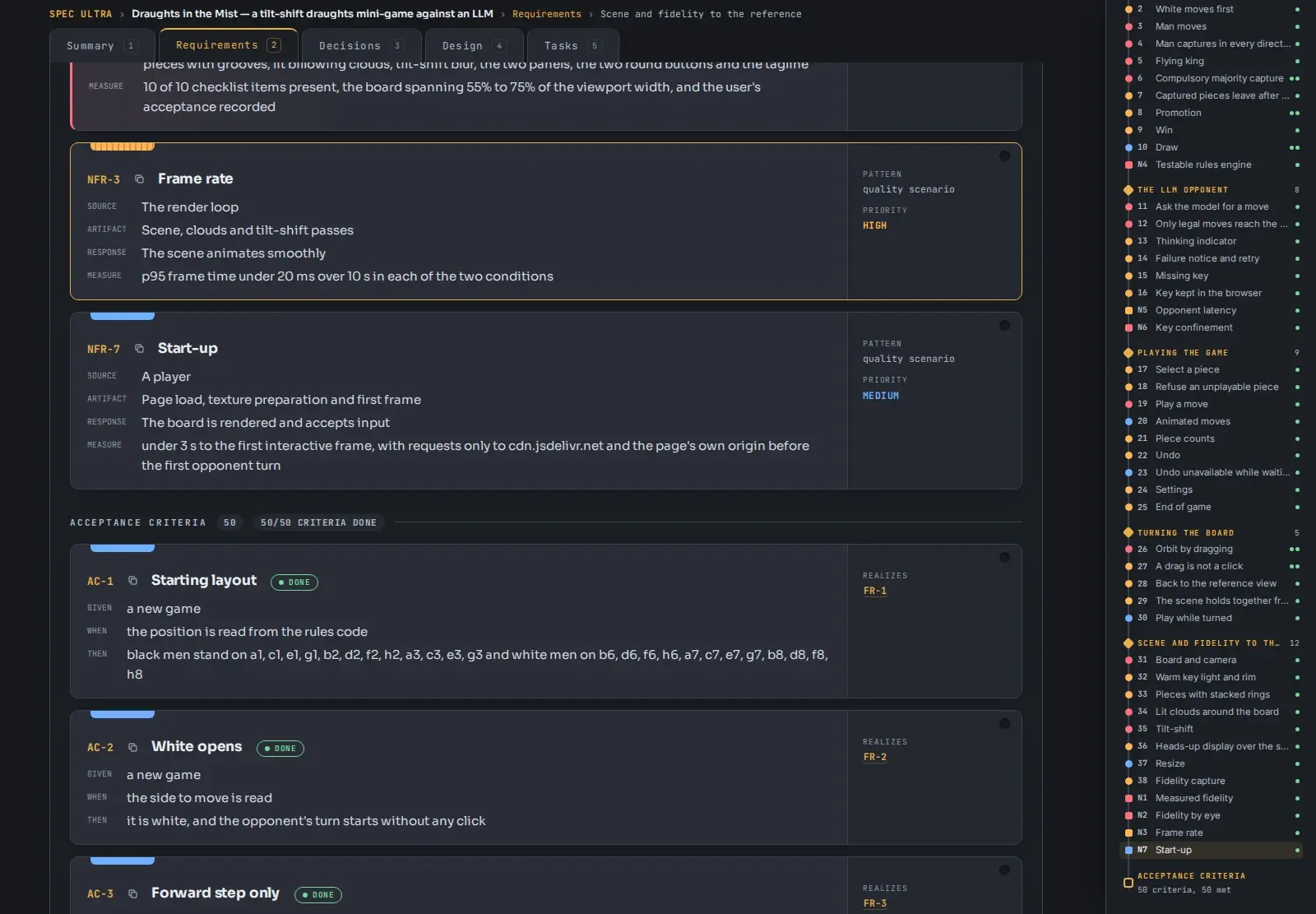
Sensory criterion · realizes NFR-2A sensory criterion: only a person can say the picture matches the reference, so the user walks the checklist and gives the verdict.

CriterionWhat is checkedRealizesVerdict
AC-1Starting layoutblack men stand on a1, c1, e1, g1, b2, d2, f2, h2, a3, c3, e3, g3 and white men on b6, d6, f6, h6, a7, c7, e7, g7, b8, d8, f8, h8FR-1met
AC-2White opensit is white, and the opponent's turn starts without any clickFR-2met
AC-15Illegal answer is retriedthe board is unchanged and a new request is sent whose message quotes the rejected move and the reasonFR-12metmeasured by a test
AC-26Undo disabled while the opponent thinksit is disabled and a click on it changes nothingFR-23met
AC-43The check reports a scoreit writes a 1672×941 capture and prints one SSIM score between 0 and 1FR-38met
AC-45Checklist and acceptanceall 10 items are present and the user accepts the resultNFR-2metjudged by the user
AC-49Key nowhere elsethere are 0 matches in files and every request carrying it goes to openrouter.aiNFR-6met
AC-50Start-up timethe board accepts input within 3 s and only cdn.jsdelivr.net and the page's own origin were contactedNFR-7met

8 of 50 criteria shown50 met · 0 failed

Proof

The report is a claim. The diff is the fact.

An example spec from the Spec Ultra repository — what was asked, decided, built and verified.

Example specDraughts in the Mist — a tilt-shift draughts mini-game against an LLMspecs/2026-09-29-damas-nevoa/

What the verifier caught

3 of the 11 findings the verifier raised.

At every checkpoint, a fresh agent that wrote none of the code checks the wave against the diff, free of the bias of the agents it judges.

Task 8

Finding

missing test

Task 8 declared tests/e2e/real-game.spec.mjs but did not write it (the user played by hand)

Task 8

Finding

test proves nothing

caveat: Task 8's measurable checks (frame p95, start-up, fidelity) also hold at the base commit

Task 9

Finding

flaky test

atmosphere.spec bottom edge-strip threshold 12 can fail at random on unseeded loads (one of 16 probes measured 11.4)

A weighed decision · ADR-5

How should the LLM opponent answer, so that only legal moves reach the board?

Chosen: Indexed legal-move menu answered through a JSON schema.

ADR-5decided by a human

How should the LLM opponent answer, so that only legal moves reach the board?

Criteriono1Indexed legal-move menu answered through a JSON schema✓ choseno2Free move notation parsed and validated by the page
legal on the first answerc1 · weight 510 × 5 = 506 × 5 = 30
latency and tokensc2 · weight 38 × 3 = 247 × 3 = 21
playing strengthc3 · weight 36 × 3 = 186 × 3 = 18
implementation simplicityc4 · weight 39 × 3 = 276 × 3 = 18
independence from provider parametersc5 · weight 27 × 2 = 149 × 2 = 18
Weighted total133105
o1
Indexed legal-move menu answered through a JSON schema
o2
Free move notation parsed and validated by the page

Weighted total = Σ weight × grade, weights 1–5, grades 1–10. o1 = 133, o2 = 105.

Robust to weights; o2 would need 6 grade points on c1 to catch up, which the first run's game rules out.

The whole spec

Every figure counted from the spec itself.

38functional req.
7non-functional
50acceptance criteria
7decisions
7diagrams
12 in 10 wavestasks
12/12tasks done
2 · 6 checkscheckpoints

so far

50 of 50 criteria met, and 11 findings raised by a verifier that wrote none of the code.

Comparison

Pick your rival.

Choose the tool you know. Rows where Spec Ultra works differently light up; rows where the two are close dim, with one line on what both do.

Kiro

Spec Ultra

Kiro and Spec Ultra work differently on 6 of 7 rows. Close on parallel execution.

  1. Price, works differently

    KiroUS$20–200 / month, credits

    Spec UltraPerpetual license, your own subscription

  2. Commands to learn, works differently

    KiroSpecs run from its IDE

    Spec Ultra2 — spec and dev (resume and status when you need them)

  3. Agents, works differently

    KiroIts own IDE and CLI

    Spec UltraAny agent with Agent Skills and a shell

  4. Verifies what was built, works differently

    KiroProperty tests, optional, IDE only

    Spec UltraA verifier that wrote none of the code at every checkpoint, plus an integrator across the whole plan

  5. Decisions, works differently

    Kiro—

    Spec UltraState-of-the-art decision support: weighted criteria, sensitivity, you decide

  6. Parallel execution, close

    BothBoth run tasks in waves from their dependencies.

    KiroDependency waves

    Spec UltraWaves from the dependency graph; tasks that touch the same file never share a wave; each wave closes through its checkpoint

  7. Spec format, works differently

    KiroMarkdown

    Spec UltraValidated files, compiled into one page you can read and share

Spec Ultra works differently on this rowclose: what both do, in one line

As of 2026-10-24.

See the full table
Kiro, Spec Kit, OpenSpec, Spec Ultra, row by row, as of 2026-10-24
KiroSpec KitOpenSpecSpec Ultra
PriceUS$20–200 / month, creditsFree (MIT)Free (MIT)Perpetual license, your own subscription
Commands to learnSpecs run from its IDE9 slash commands6 core, 12 with the expanded workflow2 — spec and dev (resume and status when you need them)
AgentsIts own IDE and CLI38 integrations30+ toolsAny agent with Agent Skills and a shell
Verifies what was builtProperty tests, optional, IDE only/analyze and /converge/opsx:verify, optionalA verifier that wrote none of the code at every checkpoint, plus an integrator across the whole plan
Decisions—Constitution only—State-of-the-art decision support: weighted criteria, sensitivity, you decide
Parallel executionDependency wavesParallel markers—Waves from the dependency graph; tasks that touch the same file never share a wave; each wave closes through its checkpoint
Spec formatMarkdownMarkdownMarkdown deltasValidated files, compiled into one page you can read and share

Price

Spec UltraPerpetual license, your own subscription

Kiro
US$20–200 / month, credits
Spec Kit
Free (MIT)
OpenSpec
Free (MIT)

Commands to learn

Spec Ultra2 — spec and dev (resume and status when you need them)

Kiro
Specs run from its IDE
Spec Kit
9 slash commands
OpenSpec
6 core, 12 with the expanded workflow

Agents

Spec UltraAny agent with Agent Skills and a shell

Kiro
Its own IDE and CLI
Spec Kit
38 integrations
OpenSpec
30+ tools

Verifies what was built

Spec UltraA verifier that wrote none of the code at every checkpoint, plus an integrator across the whole plan

Kiro
Property tests, optional, IDE only
Spec Kit
/analyze and /converge
OpenSpec
/opsx:verify, optional

Decisions

Spec UltraState-of-the-art decision support: weighted criteria, sensitivity, you decide

Kiro
—
Spec Kit
Constitution only
OpenSpec
—

Parallel execution

Spec UltraWaves from the dependency graph; tasks that touch the same file never share a wave; each wave closes through its checkpoint

Kiro
Dependency waves
Spec Kit
Parallel markers
OpenSpec
—

Spec format

Spec UltraValidated files, compiled into one page you can read and share

Kiro
Markdown
Spec Kit
Markdown
OpenSpec
Markdown deltas

Pricing

Pay once. Keep it.

Perpetual use of every version you receive, plus 12 months of updates.

Licenses go on sale soon.

Leave your e-mail and we will write to you once, on the day sales open.

Individual

One named licensee, professional use included.

Runs on the Claude or Codex subscription you already pay for. No credits, no per-model multipliers.

Business

Named seats your admin can reassign when someone leaves. One invoice.

A seat is one named person on your technical team who uses Spec Ultra — contractors included. On a Business license, your admin can change who holds a seat 30 days after it was last assigned.

RenewalKeep updates flowing: 70% in year two, 60% every year after — as long as you renew within 30 days of the period's end.

Renewal
Renew updates at 70% in year two and 60% from year three on, as long as you renew within 30 days of the period's end.
Licensing
Seats are named by e-mail; contractors count. Your license certificate is checked on your machine and lasts 7 days. Before it expires, the plugin renews it with our site, which records the serial and the IP address of the renewal; the content of your specs is not sent.
Limits
Updates, onboarding, training and support are separate deliveries. Perpetual use does not promise compatibility with every future agent release.

Privacy policy

Get started

Two commands to run.

  • Claude Code tested
  • Codex tested
  • Cursor compatible
  • GitHub Copilot compatible
  • Gemini CLI compatible
  • OpenCode compatible
claude code · specultra.dev
# first run: plan, then execute
/spec-ultra:spec
/spec-ultra:dev

The payoff

What the agents built.

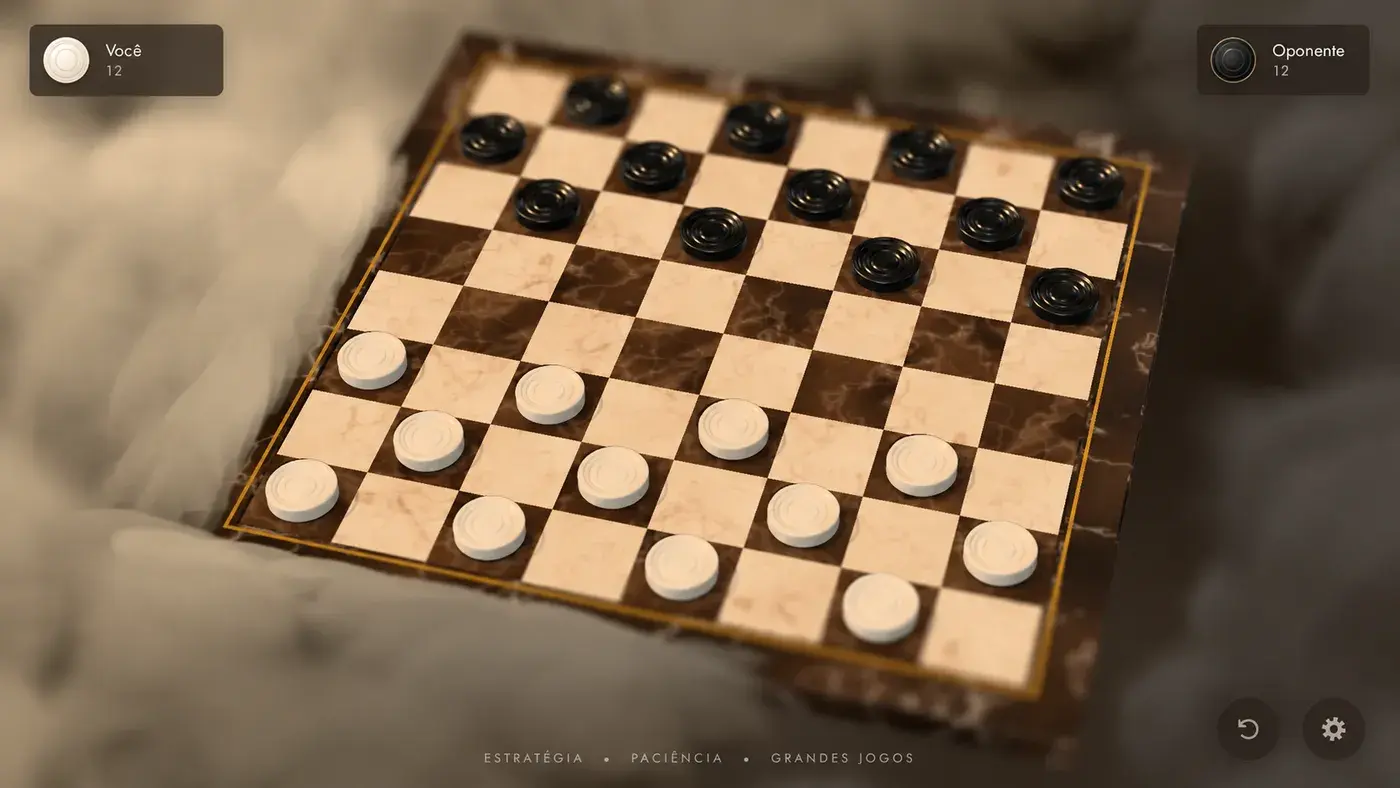
Brazilian draughts against an LLM, rendered as a tilt-shift miniature — 12 of 12 tasks done, 50 of 50 criteria met.
What the agents built

The resultThe finished game at the same 1672×941 viewport, built by the agents from the spec.

Play against the LLM

Questions

Spec-driven development, answered.

What SDD is, and what Spec Ultra adds to it.

  1. Q1

    A1

    Spec-driven development (SDD) captures requirements before any coding: the AI agent builds against the spec, and each acceptance criterion is checked against what was built.

  2. Q2

    A2

    Kiro, Spec Kit and OpenSpec write the spec as Markdown. Spec Ultra keeps it in validated files compiled into one page you can read and share, weighs every real decision against named criteria, and at every checkpoint a verifier that wrote none of the code checks the wave against the diff.

  3. Q3

    A3

    Any agent that supports Agent Skills and a shell. The installer puts Spec Ultra into the skills directory of Claude Code, Codex, Gemini CLI, Cursor, GitHub Copilot, OpenCode, Kiro and dozens more.

  4. Q4

    A4

    Requirements written as testable sentences, acceptance criteria in given / when / then, the design drawn in 17 kinds of diagram, weighed decisions, and tasks scheduled into waves from their dependency graph. The example spec on this page holds 45 requirements, 50 criteria, 7 decisions and 12 tasks.

  5. Q5

    A5

    Two commands. /spec-ultra:spec plans the spec gate by gate: research, requirements, context, decisions, tasks and a go / no-go. /spec-ultra:dev builds it wave by wave, each wave closing through its checkpoint.

  6. Q6

    A6

    Every acceptance criterion in the spec is tracked to a verdict — measured by a test, or judged by a person when only a person can judge it. The example spec closed with 50 of 50 criteria met.

  7. Q7

    A7

    No. It runs on the subscription of the coding agent you already use — Claude, Codex, Copilot, Cursor or any other. No credits, no per-model multipliers. A license includes 12 months of updates, and every version you receive stays licensed whether you renew or not.

  8. Q8

    A8

    Yes. The spec compiles into one HTML file that shows what was asked, decided, built and verified. Send it as a link or an attachment to a manager or a client.

Your agent says it’s done. Spec Ultra proves it.

Get Spec Ultra

Runs on the Claude or Codex subscription you already pay for. No credits, no per-model multipliers.